Level 0 # Speaking Section

Speaking section of IELTS consist of three sections. However, before the actual speaking section of IELTS begins, there is this part where you will introduce yourself and greet the examiner. Well, although nothing much can go wrong here and neither you are marked much on this section, but answering it right will help you to achieve higher band.

In this section, the examiner will introduce themselves by saying either of the following things –

Good after noon, my name is this.

Could you tell me your full name?

You need to answer,

Good afternoon, name of the examiner. My name is

You may or may not give the name of the examiner.

NOTE –  

  1. If you are going to use the examiner name don’t use titles. For example, miss, Mrs., Mr. but if you don’t feel comfortable saying the examiner’s name, it is completely fine.
  2. When telling your name, you can say either of the following sentences –

My name’s anmol.

Now, did you saw, I said my name’s and not my name is. This is part of pronunciation. Using contractions is a part of higher level of pronunciation. Doing so, will help you in having a good impression over the examiner.

Note – Speak your name clearly. Smile properly and look in the examiner’s  eyes while answering, but make sure you don’t stare.

The second question that you will be asked is What can I call you?

There are three ways you can reply –

  1. You can call me ..
  2. Just call me ….
  3. Please call me ….

Note- Please don’t explain why people call you this.

There are many people who have an English name apart from a vernacular name. They can say – You can call me by my English name

The third question is Where are you from?

Or Could you tell me where you come from?

  1. I am from India
  2. I come from Honk Kong
  3. I come from ….
  4. I am from Calcutta which is in the east of India.

Note -It is good to add little bit information.

“which is in the” is a clause. Using it will help you in getting higher marks. Don’t expand any further.

Don’t ask examiner questions.

Don’t give recommendations.

Use English pronunciation of names. Don’t use vernacular word.

The fourth question asked is Could I see your identification?

Or Can you show me your identification?

You can answer this question as –

  1. Here you are
  2. Sure, here you are
  3. Of course, here it is.

Note –

Keep the answer short.

ID is identification

It is possible to say nothing and give your id but it is better if you say something.

So, go on do the right things and prove your metal in IELTS.

IELTSBAND7


Understanding Graphs – 2

We already have talked about dynamic graphs and how to write an overview for the dynamic graphs. Now, let us have a look at the other kind of graph i.e. the static graph.

Static graph is a graph in which the data is provided for a fixed point of time.

Let us understand how they are answered with the help of the following example.
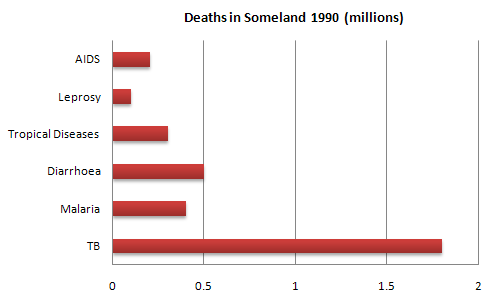
 

Deaths In SomeLand

Deaths In Someland

The following graph shows data from just one point in time. We can therefore not talk about general trends over time. Here, the major concern is over comparing data between the various sources. Here, we will be comparing the different diseases.

Now, let us first understand this graph. What are the things that you can understand by simply seeing this graph.

First, TB crosses the mark of 1.5 and hence causing the major deaths. The next major disease is diarrhea while Leprosy and AIDS cause the least number of deaths.

Now, let us try to write an overview of the graph –

The graph compares the deaths caused by six diseases in Someland with TB causing the major deaths while Leprosy effecting the least number of people. Apart from TB and Leprosy, the number of deaths are almost same for all other disease.

When we look at static graphs we should be looking for:

  • What are the highest/lowest values?
  • What are the most noticeable differences?
  • Any similarities?
  • Any significant exceptions?

What else to take into consideration?

Try making complex sentences by using sub ordinate clauses.  Complex sentences are sentences with more than one clause and they help increase our marks in the grammatical range part of the marking criteria. You can make sub ordinate clauses by using words such as ‘while’. ‘although’, ‘with’, ‘even though’, ‘whereas’ or ‘and’.

General Structure of the IELTS writing task 2

Paragraph 1- Paraphrase Sentence

Paragraph 2- Overview

Paragraph 3- Details

Paragraph 4- Details

Remember, you need not to write any conclusion.
IELTSBAND7


Understanding Graphs – 1

To explain graph properly, it is very important to understand the different types of graphs that come in IELTS. I know you must have heard of pie chart, line graph, tables, but let us have a look at the graphs from a new perspective.

  1. Static Graphs
  2. Dynamic Graphs

Static Graphs – These are the graphs that show data over a certain period of time.

Dynamic Graphs- These are the graphs that show data over a period of time.

Let us have a look at each type of the graph.

Dynamic Graphs –

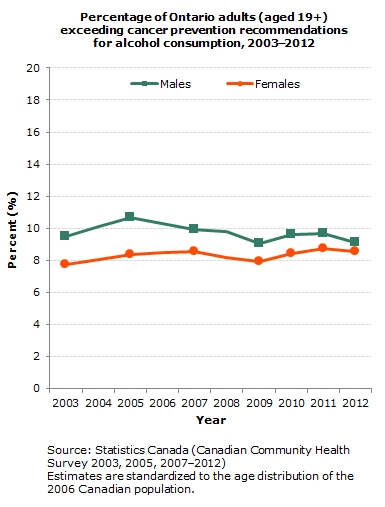
The graph below shows the percentage of Ontario adults, exceeding cancer prevention recommendations for alcohol consumption, from 2003 to 2012.

Summarize the information by selecting and reporting the main features, and make comparisons where relative.

Write at least 150 words.

Percentage Of Adults

Percentage Of Adults

As you can see, the graph is dynamic because it shows data over a period of time. We should therefore look at the general trend over the time period.

First we need to look at what happened to both the lines from the start to the end. We can see that the green line decreased a bit, while the orange line increased little. Now, let us have a look at both the lines separately. The green line increases till 2005 and then decreases till 2009, finally lowering at 2012.The orange line increases till 2007, decreases till 2009 and then increases till 2012.

These are the most striking or most obvious things we can see when first looking at the graph and these are perfect for our overview.

Let’s put this information into a sentence:

Over the entire period of time, number of males and females, exceeding cancer prevention, showed opposite trends. Females saw a steady increase till 2007 before declining till 2009 and then marking an overall increase. While, percentage of males rocketed, reaching highest point in 2005, before ending up at a decrease in 2012.

When we are looking at dynamic graphs we should be looking out for:

  • What does the data do from the start to the finish?
  • Do they generally go up or down or do they fluctuate?
  • Any significant difference from the general trend?
  • Overall increase/decrease?
  • Peaks/lows?

IELTSBAND7

How To Write An Overview

Overview is the most important part of the writing task 1 of IELTS. The examiner tends to read the overview of the answer first, before reading your other part of the answer. It is therefore very important for you to answer it properly. You need to write it in a way that the examiner gets a clear view of the main trends of the graph,and the other important information that can be grasped from the graph.

What Are You Expected To Write?

Now, if you want a

Band 5 – Relate details mechanically with no clear overview; there  may be no data to support the description

Band 6- Present the overview with information appropriately selected

Band 7- Present the overview clearly telling the main trends, differences and similarities.

What Is An Overview?

Overview is the paragraph that contains  a short summary of the main features. This is done by picking out the 3-4 most significant trends that you notice and then writing them plainly. You need not to either support or go against it. All you are required to do is tell them plainly in the paragraph.

Summarise the information by selecting and reporting the main features, and make comparisons where relevant.

This is the sentence you will see after the main question in almost every writing task 1 of the IELTS and this is exactly what you need to do in the overview paragraph.

Let us take an example.

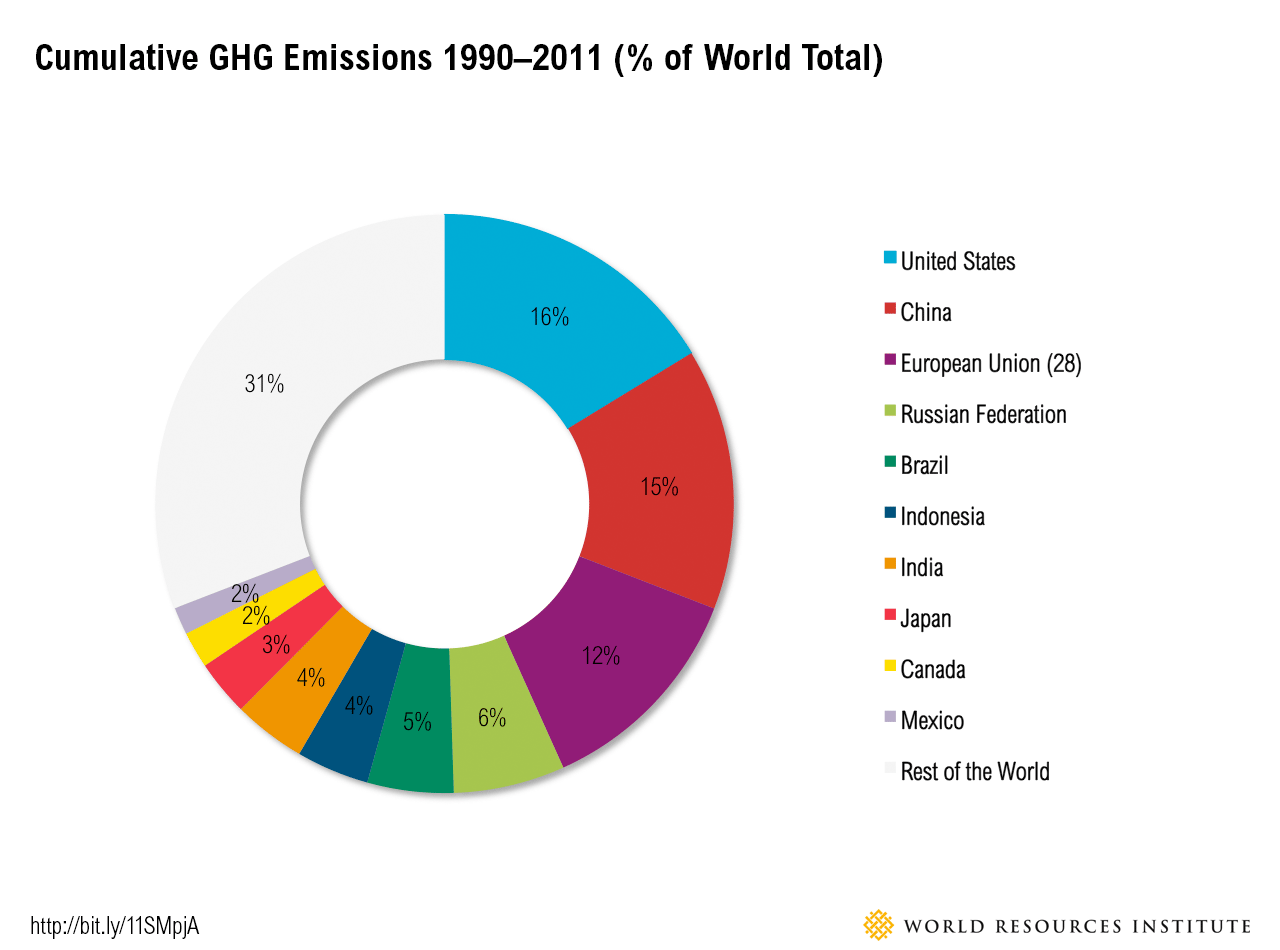
cumulative_emissions of GHG

cumulative_emissions of GHG

Overall there are 10 regions. United States, China, European Union, Russian Federation, Brazil, Indonesia, India, Japan, Canad, Mexico and the rest of the world.Out of these, United States, Japan and European Union and the rest of the world make up the majority, with the rest of the world being the largest. Mexico and Canada  make up a very small proportion.

We can then include these things in an overview paragraph:

The pie chart is comprised of ten regions in total with United States, Japan and European Union contributing maximum to the green house emission. United States has the single biggest share and Mexico, Canada cause the least green house gas emission.

Now, here have I talked about any numbers, who is greater than the other by how much. In this paragraph i.e. the over view paragraph all that I have done is reported what I saw visually and that is exactly what you need to do in the overview paragraph.

IELTSBAND7

1 443 444 445 446 447 537