Number Of Catholics # Graph For IELTS

You should spend about 20 minutes on this task.

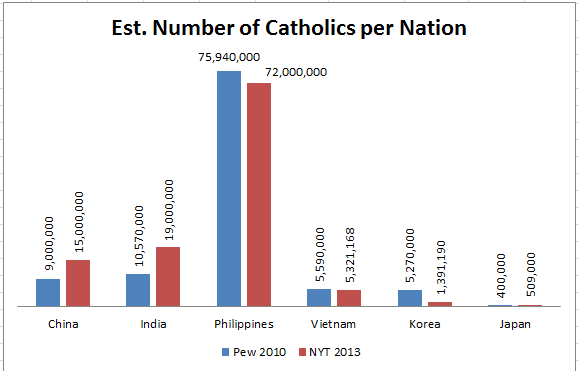
The graph below gives information about the number of Catholics residing in different nations, during 2010-2013.
Summarise the information by selecting and reporting the main features, and make comparisons where relevant.

Write at least 150 words.

Number Of Catholics

Number Of Catholics

SAMPLE ANSWER

The graph compares the number of Catholics living in six different countries of the world; China, India, Philippines, Vietnam, Korea and Japan, during a span of three years, i.e. from 2010 to 2013.

Over the entire period of time, most of the Catholics preferred to reside in Philippines, while Japan had the least number of Catholics. The countries to the left of Philippines, in the graph, showed a considerable figure of Catholics, however, the ones to the right of Philippines marked a glooming picture of numbers of Catholics residing.

Philippines had the majority of Catholics, with over 70 million of them living there during 2010. However, this figure showed a slight dip by 2013, yet making it the country with maximum of Catholics. On the other hand, Japan showed an upward trend. The population of Catholics in Japan increased approximately 100 thousand.

Catholics finding livelihood in China and India went up during the period of 2010 to 2013 with India making a higher rise of 90 million as compared to 60 million in China. The situation remained almost steady in Vietnam, with only a slight increase but a slump was observed in Korea.

IELTSBAND7


How Many Words ?

The most confusing part of IELTS writing task, be it writing task 1 or writing task 2, is how many words do you need to write? Although, it is clearly written at least 150 words and at least 250 words, the most important confusion is whether you need to write exact number of words or more or is it okay to write few words less than the given word limit. You must have heard the following two things from people –

  1. You need not to write 250 or 150 words. Even if you write 10 words below the given word limit, it is perfectly fine and you will not lose marks.
  2. You must write, whatever you feel like. No body cares about the word limit, you must write, that much which will fetch you more marks.

WHAT IF YOU WRITE BELOW THE WORD LIMIT?

Well, you must be wondering, what if you wrote, 149 or 249 words in the  two writing tasks?? Nothing much you will lose marks. The question clearly states that you must write at least 150/250 words . This means that you have to write these many words, and then you can even exceed. Remember, the examiners are very particular about the word limit and they actually go on to count them, so make sure you write minimum of 150/250 words, failing to which, will make you lose marks.

SO, DOES THAT MEAN YOU NEED TO WRITE MORE WORDS?

Well, writing more words, could land you in trouble if you write a lot.

  1. There is a time limit for both the tasks. If you put a lot of time on one task, you are sacrificing on the other task. Remember, just because you wrote more on one task than was required, does not mean you will get marks for the next task.
  2. Grammar mistakes become more evident if you write more than the word limit. Just imagine, if you keep on writing, it becomes very easy for you to make grammar errors, and this will bring down the overall marking.
  3. It is not only about writing, but also about planning and rechecking. Even more, you are marked on the basis of your quality and not on quantity. Make sure, you write well and check well.


THEN, HOW MANY WORDS SHOULD YOU WRITE?

Make sure you write, 10% above than the prescribed word limit. This means, you need to aim for writing 160-170 in the writing task 1 and 260-270 words in the writing task 2. But then, does it mean you need to actually go about and counting the words during the exam!! Well, no. There is a better way. Go on and download the official sheets of the IELTS and practice writing on them. After some time, you will be familiar with the answer sheet, making it easier for you to write during exams.

ARE ALL THE WORDS SAME?

Well, No. Hyphenated words such as First-class are counted as one word. Even more, the contraction words such as I’ll are counted as one word.

Remember, you cannot copy words from the question.

Learn the art of PARAPHRASING and score high.

IELTSBAND7

Level 0 # Speaking Section

Speaking section of IELTS consist of three sections. However, before the actual speaking section of IELTS begins, there is this part where you will introduce yourself and greet the examiner. Well, although nothing much can go wrong here and neither you are marked much on this section, but answering it right will help you to achieve higher band.

In this section, the examiner will introduce themselves by saying either of the following things –

Good after noon, my name is this.

Could you tell me your full name?

You need to answer,

Good afternoon, name of the examiner. My name is

You may or may not give the name of the examiner.

NOTE –  

  1. If you are going to use the examiner name don’t use titles. For example, miss, Mrs., Mr. but if you don’t feel comfortable saying the examiner’s name, it is completely fine.
  2. When telling your name, you can say either of the following sentences –

My name’s anmol.

Now, did you saw, I said my name’s and not my name is. This is part of pronunciation. Using contractions is a part of higher level of pronunciation. Doing so, will help you in having a good impression over the examiner.

Note – Speak your name clearly. Smile properly and look in the examiner’s  eyes while answering, but make sure you don’t stare.

The second question that you will be asked is What can I call you?

There are three ways you can reply –

  1. You can call me ..
  2. Just call me ….
  3. Please call me ….

Note- Please don’t explain why people call you this.

There are many people who have an English name apart from a vernacular name. They can say – You can call me by my English name

The third question is Where are you from?

Or Could you tell me where you come from?

  1. I am from India
  2. I come from Honk Kong
  3. I come from ….
  4. I am from Calcutta which is in the east of India.

Note -It is good to add little bit information.

“which is in the” is a clause. Using it will help you in getting higher marks. Don’t expand any further.

Don’t ask examiner questions.

Don’t give recommendations.

Use English pronunciation of names. Don’t use vernacular word.

The fourth question asked is Could I see your identification?

Or Can you show me your identification?

You can answer this question as –

  1. Here you are
  2. Sure, here you are
  3. Of course, here it is.

Note –

Keep the answer short.

ID is identification

It is possible to say nothing and give your id but it is better if you say something.

So, go on do the right things and prove your metal in IELTS.

IELTSBAND7


Understanding Graphs – 2

We already have talked about dynamic graphs and how to write an overview for the dynamic graphs. Now, let us have a look at the other kind of graph i.e. the static graph.

Static graph is a graph in which the data is provided for a fixed point of time.

Let us understand how they are answered with the help of the following example.


Deaths In SomeLand

Deaths In Someland

The following graph shows data from just one point in time. We can therefore not talk about general trends over time. Here, the major concern is over comparing data between the various sources. Here, we will be comparing the different diseases.

Now, let us first understand this graph. What are the things that you can understand by simply seeing this graph.

First, TB crosses the mark of 1.5 and hence causing the major deaths. The next major disease is diarrhea while Leprosy and AIDS cause the least number of deaths.

Now, let us try to write an overview of the graph –

The graph compares the deaths caused by six diseases in Someland with TB causing the major deaths while Leprosy effecting the least number of people. Apart from TB and Leprosy, the number of deaths are almost same for all other disease.

When we look at static graphs we should be looking for:

  • What are the highest/lowest values?
  • What are the most noticeable differences?
  • Any similarities?
  • Any significant exceptions?

What else to take into consideration?

Try making complex sentences by using sub ordinate clauses.  Complex sentences are sentences with more than one clause and they help increase our marks in the grammatical range part of the marking criteria. You can make sub ordinate clauses by using words such as ‘while’. ‘although’, ‘with’, ‘even though’, ‘whereas’ or ‘and’.

General Structure of the IELTS writing task 2

Paragraph 1- Paraphrase Sentence

Paragraph 2- Overview

Paragraph 3- Details

Paragraph 4- Details

Remember, you need not to write any conclusion.

IELTSBAND7


1 442 443 444 445 446 536